
PRESS RELEASE
Conservation Groups Urge Governments to Reject Biofuels in Shipping Decarbonization Plans
As the International Maritime Organization negotiations open in London, a group of conservation organisations calls on governments to reject biofuels as a decarbonisation pathway for international shipping
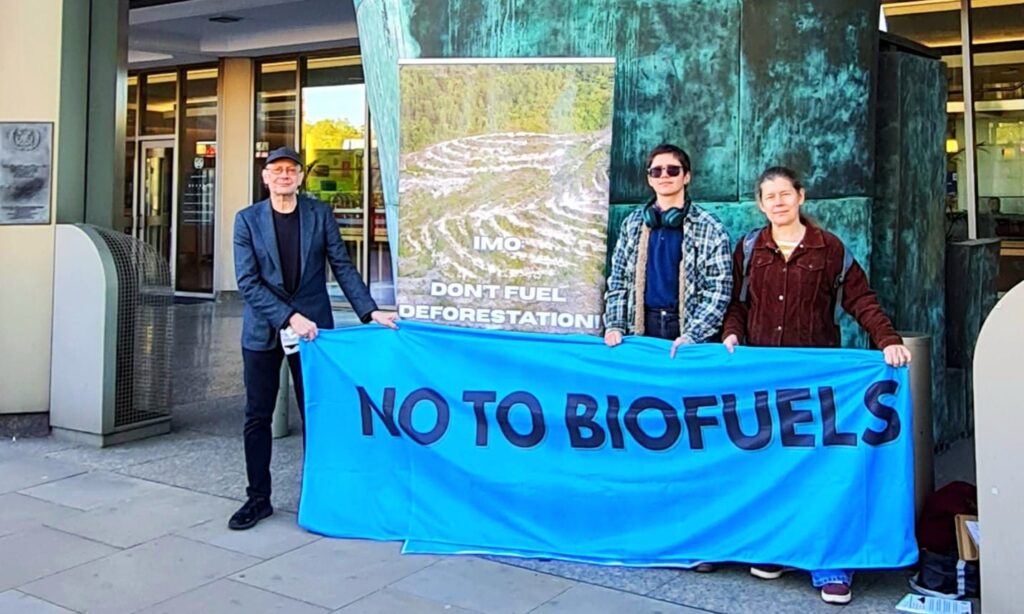
London, 20 April 2026 – As delegates convene today at the International Maritime Organization (IMO) headquarters for the 21st session of the Intersessional Working Group on Greenhouse Gases (ISWG-GHG-21), a number of conservation and environmental justice organisations – lead by Biofuelwatch and Global Forest Coalition – are issuing a call to member states to not allow biofuels to be counted as a green solution to shipping's climate problem.
The group, representing organisations working across Latin America, Southeast Asia, Africa and Europe, warns that endorsing biofuels within the IMO's decarbonization pathway would accelerate deforestation, drive land grabs, threaten biodiversity and deepen food insecurity in some of the world's most vulnerable regions.
“Biofuels are being promoted as a climate solution for shipping, but the reality on the ground tells a very different story,” said Xavier León, Member of the Latin America Program at Grain. “From Indonesia to Latin America, expanding biofuel production at the scale required by global shipping would have devastating consequences.”
The evidence from regions already affected by industrial biofuel production is extensive:
- Deforestation and biodiversity loss: In countries such as Indonesia, the expansion of palm oil plantations has been a major driver of tropical deforestation, threatening critical habitats for endangered species and accelerating climate change through carbon-rich peatland destruction.
- Land-use change and emissions: In Latin America, increased cultivation of crops like soy for biofuels has contributed to land-use change, often displacing forests and lands that act as vital carbon sinks. These indirect emissions can negate or even exceed the purported climate benefits of biofuels.
- Impacts on local communities: Biofuel expansion has been associated with land grabbing, displacement of Indigenous peoples, and heightened social conflict, particularly in rural areas where governance protections are weak.
- Food security risks: Diverting agricultural land to fuel production places additional pressure on global food systems, contributing to price volatility and reduced access to staple crops in vulnerable regions.
"As the demand for biofuels for shipping rises, the pressure on ecosystems and indigenous communities intensifies. In Indonesia, palm oil concessions overlapping with indigenous territories cover 2.26 million hectares – an area larger than the island of Bali. Biofuels are far more than a matter of energy, they are a struggle for social and ecological justice”, said Respati Bayu, Researcher at Forest Watch Indonesia.
The IMO is under mounting pressure to finalise its decarbonisation framework for international shipping, a sector responsible for nearly 3% of global greenhouse gas emissions. While the group strongly supports the sector's urgent decarbonisation, it warns that biofuels offer an accounting fiction rather than a genuine emissions reduction.
"We have watched our forests disappear to fuel cars in Europe," said Eko Yunanda, Director of WALHI Riau. "We cannot now stand by while the same logic is extended to fuel the ships crossing our oceans."
“Governments have a responsibility to ensure that the transition to zero-emission shipping does not come at the expense of forests, communities, and food systems,” said Pax Butchart, Biofuelwatch campaigner. “Excluding biofuels from the decarbonization pathway is a necessary step toward a truly sustainable future.”
The NGOs warn that classifying biofuels as “green” shipping fuels risks locking the sector into a pathway that fails to deliver genuine emissions reductions. Instead, the group urges IMO member states to prioritize truly zero-emission solutions, such as speed reduction and wind propulsion.
Background information
ISWG-GHG-21 runs from 20-24 April and will be followed by the 84th session of the Marine Environment Protection Committee (MEPC 84) on 27 April - 1 May 2026 at IMO Headquarters in London. The sessions are expected to address the emissions associated with fuels and technologies, including biofuels, and the IMO's Net-Zero Framework.
Despite the delay in the adoption of the Net-Zero Framework, the 2023 IMO GHG Strategy remains in place, setting net-zero targets for the IMO and international shipping by 2050.
Media Contact
Pax Butchart, Biofuel Campaigner at Biofuelwatch, pax.biofuelwatch@gmail.com
Sign-ons


